

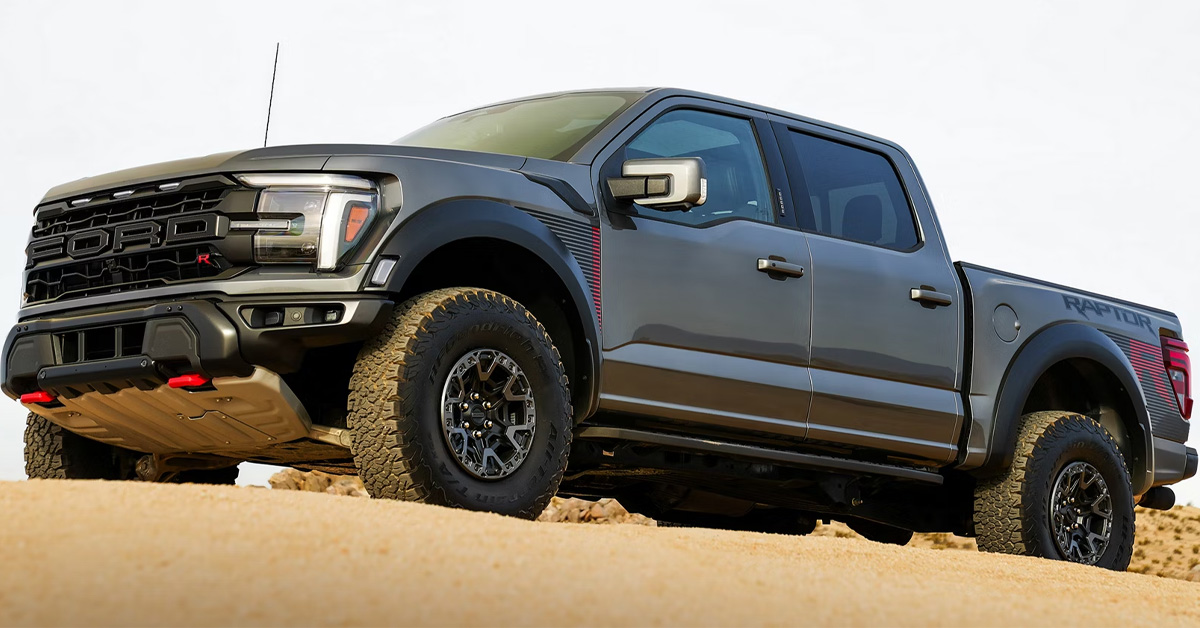
The 2026 Ford F-150 and Ram 1500 remain two of the most competitive trucks in the segment, but the F-150 often pulls ahead in key areas like towing strength, powertrain variety, and work-ready capability. When comparing the Ford F-150 vs RAM 1500, the F-150 stands out for its broader engine lineup, higher maximum capability ratings, and advanced towing-focused technology, making it a strong choice for demanding work and everyday versatility.
Diamond Ford is proud to support drivers throughout Lancaster, Palmdale, Antelope Valley, and Mojave with expert automotive care and a wide selection of trucks built for real-world performance. Whether you are researching, shopping, or ready for your next vehicle, our team is here to help with sales, service, and parts support at every step. Contact Diamond Ford today or stop by to see how we can help you find the right Ford for your needs.
Which Truck Delivers Stronger Towing and Payload Capability?
When capability is the deciding factor, towing and payload strength quickly become the most important part of the conversation. In a Ford F-150 vs RAM 1500 comparison, both trucks are built to handle serious work, but the Ford consistently pushes higher maximum capability numbers and more work-focused engineering. That difference shows up most clearly when trailers get heavier, cargo stacks higher, or the road conditions become less forgiving.
For drivers across Lancaster, Palmdale, and the surrounding Antelope Valley region, that capability is not theoretical. It is the difference between a smooth workday and repeated strain on the truck when hauling equipment, trailers, or recreational loads out toward Mojave and beyond.
Towing Strength Under Real-World Conditions
A Ford vs RAM truck comparison for 2026 often comes down to how each vehicle behaves when fully loaded. While both models can tow impressive weights, the Ford lineup is engineered with a strong focus on sustained towing confidence and stability.
Here is where the 2026 Ford F-150 stands out:
- Best-in-Class Maximum Towing: Up to 13,500 lbs when equipped with the 3.5L EcoBoost® V6 engine and the Max Tow/Haul Package. This twin-turbocharged V6 produces 400 horsepower and 500 lb-ft of torque, giving the F-150 strong low-end pulling power for trailers, boats, equipment, and recreational loads.
- Hybrid Hauling: The 3.5L PowerBoost® Full Hybrid V6 delivers 430 horsepower and 570 lb-ft of torque while towing up to 11,600 lbs, giving drivers impressive capability with added efficiency for daily driving.
- V8 Dependability: The available 5.0L Ti-VCT V8 engine produces 400 horsepower and 410 lb-ft of torque and handles up to 12,800 lbs of towing capacity when properly equipped.
Here is where the 2026 RAM 1500 stands:
- Maximum Towing: Up to 11,610 lbs when properly equipped with the new 3.0L Hurricane Twin-Turbo I-6 engine, which produces 420 horsepower and 469 lb-ft of torque.
- High-Output Option: The high-output version of the 3.0L Hurricane Twin-Turbo I-6 engine produces 540 horsepower and 521 lb-ft of torque. While it delivers stronger performance numbers, its maximum towing capacity reaches 10,000 lbs.
- Everyday Utility: The available 3.6L Pentastar V6 engine with eTorque mild-hybrid technology produces 305 horsepower and 269 lb-ft of torque and can tow up to 8,130 lbs when properly equipped.
These advantages in the F-150 are especially noticeable when pulling larger trailers, construction equipment, or multi-axle loads across uneven desert highways or rural job routes. Ram still delivers solid towing performance, particularly for light to mid-range trailers, but its setup often emphasizes ride smoothness (via its available Active-Level Four-Corner Air Suspension) and cabin comfort while towing rather than maximum output.
Explore the exact towing and payload specs by trim and engine configuration side-by-side:
Payload Capacity That Supports Heavy Workloads
Payload strength is another area where the differences in F-150 vs RAM 1500 features become easier to feel in daily use. Payload is not just about numbers on paper; it is about how confidently a truck handles weight in the bed without sacrificing stability or control.
- Ford F-150: Achieves a best-in-class maximum payload of 2,440 lbs (with the 3.5L EcoBoost V6 in a Regular Cab setup). Even the V8 configurations boast up to 2,235 lbs of payload capacity.
- RAM 1500: Peaks at 2,370 lbs of payload capacity, which requires the standard 3.6L Pentastar V6 engine.
This matters for contractors and small business owners who regularly load pallets, tools, or landscaping equipment. Even a short drive through city traffic in Lancaster becomes more demanding when the truck is fully loaded, and the F-150’s stronger frame and suspension tuning offer better balance when carrying uneven or shifting cargo.
How Do Interior Features and Cabin Utility Compare?
Cabin design has become just as important as power and capability for many drivers, especially those who spend long hours on the road or use their truck as a mobile workspace. In a Ford vs RAM comparison, both trucks bring strong interior offerings, but they take noticeably different approaches.
Ford’s Approach: Built for Work and Adaptability
The Ford cabin is designed to handle real-world tasks without sacrificing comfort. It focuses on usability and smart storage solutions that make long workdays easier:
- Interior Work Surface: The F-150 offers an available fold-flat center console that turns into a desk for laptops, paperwork, or meals.
- Pro Power Onboard: Available up to 7.2kW, turning the truck bed into a mobile generator capable of running power tools, air compressors, lights, or camping gear directly from the truck. The system is available with select 2.7L EcoBoost V6, 3.5L EcoBoost V6, and 3.5L PowerBoost Full Hybrid V6 configurations.
- Lockable Under-Seat Storage: Keeps expensive tools and valuables hidden and secure.
Ram’s Approach: Premium Comfort and Refinement
Ram focuses more heavily on a luxury feel and soft-touch materials. The cabin is often described as one of the most comfortable in the segment:
- Class-Leading Screens: Available massive 14.5-inch Uconnect 5 touchscreen and a segment-exclusive 10.25-inch front passenger interactive display.
- Luxury Materials: Upscale seating materials, real wood accents on higher trims, and available premium leather.
- Ride Quality: A smooth, quiet cabin experience on highways, largely thanks to its coil-spring rear suspension and available air suspension.
What Technology Features Separate the Two Trucks?
Technology has become one of the most important deciding factors in a modern truck comparison. One is built around work-ready intelligence and hands-free driving capability, while the other focuses heavily on a premium digital cabin experience.
Driver Assistance and Hands-Free Capability
Ford’s BlueCruise vs. RAM’s Active Driving Assist:
Ford integrates technology with a strong focus on reducing fatigue. Ford’s BlueCruise offers true hands-free highway driving on over 130,000 miles of prequalified sections of divided highways. RAM counters with its Hands-Free Active Driving Assist, which operates similarly on approved roadways, though Ford’s system has a slightly longer track record in the market.
Towing and Trailer Tech:
- Ford: Features Pro Trailer Hitch Assist (which automatically controls steering, speed, and braking to align the hitch with the trailer) and Onboard Scales to estimate payload weight in real-time, preventing overloading.
- RAM: Offers Trailer Auto Hitch Assist and advanced surround-view camera systems for tight maneuvering.
Which Truck Performs Better in Off-Road and Heavy-Duty Conditions?
Off-road trails and heavy-duty work environments are where a truck’s engineering really gets tested.
Ford’s Off-Road Focus: Purpose-Built Rugged Performance
Ford engineers its off-road models (like the Tremor, Raptor, and 720-hp Raptor R) with a strong emphasis on control and durability.
The F-150 Raptor uses a 3.5L EcoBoost V6 engine producing 450 horsepower and 510 lb-ft of torque, while the Raptor R delivers extreme performance with a 5.2L supercharged V8 producing 720 horsepower and 640 lb-ft of torque. These models feature available off-road-tuned suspension systems, advanced drive modes (Baja, Rock Crawl, Mud/Ruts, and more), and Trail Control technology that assists with throttle and braking over harsh terrain.
The F-150 Tremor also adds off-road capability with specialized suspension tuning, all-terrain tires, skid plates, and selectable drive modes designed for drivers who regularly travel over dirt roads, trails, and uneven job sites.
Ram’s Off-Road Focus: Comfort with Capability
Ram’s off-road trims (like the Rebel or the new RHO) also perform well, but the tuning often prioritizes ride comfort alongside trail ability. With its specialized suspension tuning, it shines at absorbing bumps for high-speed desert running, though for pure structural workload consistency (hauling heavy equipment across unpaved roads), the F-150’s high-strength frame is hard to beat.
The Verdict
While both trucks offer incredible modern features, the Ford F-150 holds distinct advantages over the RAM 1500 for those who need a true workhorse. With a higher maximum towing capacity (13,500 lbs vs 11,610 lbs), a higher max payload (2,440 lbs vs 2,370 lbs), exclusive work-focused tech like Pro Power Onboard, and a wider variety of powertrains, including a highly capable Full Hybrid option, the F-150 remains the definitive choice for pure capability in the Antelope Valley.
How does the 2026 F-150’s towing compare to the RAM 1500’s?
A Ford F-150 can tow up to approximately 13,500 pounds when properly equipped, while a Ram 1500 can tow up to about 11,610 pounds when properly equipped.
How do the interior features compare between the F-150 and RAM 1500?
The Ford F-150 emphasizes functionality and work-ready utility, such as available interior work surfaces and storage solutions, while the Ram 1500 focuses more on premium materials, comfort, and a luxury-style cabin experience.
Which truck holds its value better—Ford or RAM?
The Ford F-Series line, including the F-150, generally holds its value better due to long-standing market leadership, strong demand, and reputation as America’s best-selling truck for decades.
Find Your Next Pickup Truck at Diamond Ford in Lancaster, CA
Choosing between two well-matched vehicles often comes down to the details that matter most in daily driving, whether that is capability, comfort, or long-term value. For drivers who are still exploring options beyond the Ford F-150 and Ram 1500, there are additional comparisons that take a closer look at how Ford models stack up against other popular choices in the segment. Insights like those found in Ford Escape Platinum vs Mazda CX-5 Signature comparisons, Ford Escape Platinum vs Toyota RAV4 Limited trim guide breakdowns, and Ford Escape Active vs Nissan Rogue S comparisons can help clarify how Ford vehicles perform across different categories and lifestyles. These resources are especially helpful for drivers who want to understand how design, efficiency, and technology vary across today’s most competitive SUVs.
At Diamond Ford, drivers from Lancaster, Palmdale, Antelope Valley, and Mojave are invited to explore a wide selection of vehicles built for work, family, and everyday driving. Whether you are comparing full-size trucks or compact SUVs, our inventory includes options like the Ford F-150 and Ram 1500, along with many other capable models to fit different needs and budgets. Our team is here to help you explore features, compare trims, and find a vehicle that fits your routine both on and off the road.
If you are ready to take the next step, reach out to Diamond Ford or visit us in person to experience these vehicles firsthand. From capability-focused trucks to efficient family SUVs, we are here to help you make a confident choice for your next vehicle.
Get Directions to Diamond Ford
Disclaimer: All information is provided for general informational and entertainment purposes only. While we strive for accuracy, we cannot guarantee that all content is complete, current, or error-free. Any reliance you place on such information is strictly at your own risk. This article may include opinions and is not endorsed by, or officially affiliated with, any vehicle manufacturer or brand. Always consult official sources – such as the vehicle’s owner’s manual, authorized dealerships, or certified professionals – for the most up-to-date and personalized information.


Warning: Operating, servicing and maintaining a passenger vehicle or off-road vehicle can expose you to chemicals including engine exhaust, carbon monoxide, phthalates, and lead, which are known to the State of California to cause cancer and birth defects or other reproductive harm. To minimize exposure, avoid breathing exhaust, do not idle the engine except as necessary, service your vehicle in a well-ventilated area and wear gloves or wash your hands frequently when servicing your vehicle. For more information go to www.p65warnings.ca.gov/passenger-vehicle.